
Holding Company Dubai Property Investments in 2026

If you are thinking about putting your money into Dubai real estate in 2026, you are not alone. The market keeps pulling in global investors who want high rental yields and a stable place to grow their wealth. According to a recent report, Dubai property investment in 2026 offers exceptional returns for foreign buyers looking for reliable income and long term security. The numbers back this up. The UAE has seen a surging property market with prices reaching pre-2008 levels again, as noted in the BTI Country Report 2026.
But here is the thing. Jumping into a foreign market without the right setup can get messy fast. You need to understand local rules, tax laws, and the best way to own property. That is where corporate structures come in. Many savvy investors use holding companies to make everything cleaner and more efficient.
A holding company lets you own multiple assets under one umbrella. It makes asset management simpler, protects your privacy, and helps with tax planning.
This guide walks you through exactly how holding companies can optimize your property investments in Dubai. We will cover the legal steps, the tax benefits, and how to set everything up the right way. Whether you are a first time buyer or a seasoned investor, knowing this structure can save you time, money, and stress.
If you want to learn how holding companies can work for your specific situation, connect with Ayaz Salman on WhatsApp for a free consultation. It is a simple first step toward making your Dubai investment plan stronger and smarter.
Why Use a Holding Company for Dubai Property?
You already know Dubai is a hot market in 2026. Foreign investment is strong, and property values are climbing. According to the BTI Country Report 2026, the UAE property market is surging and prices are back to pre-2008 levels. That kind of growth is exciting. But it also means you need a smart setup to protect what you build.
Here is why a holding company is the right move for most serious investors.
It keeps your personal money safe. This is the biggest reason to use this structure. When you own property under your own name, any problem with that property can put everything you own at risk. A tenant could sue you. A contractor could file a claim. Without protection, those risks touch your personal bank accounts and assets back home. A holding company creates a legal wall between you and your investments. The company takes the liability, not you.
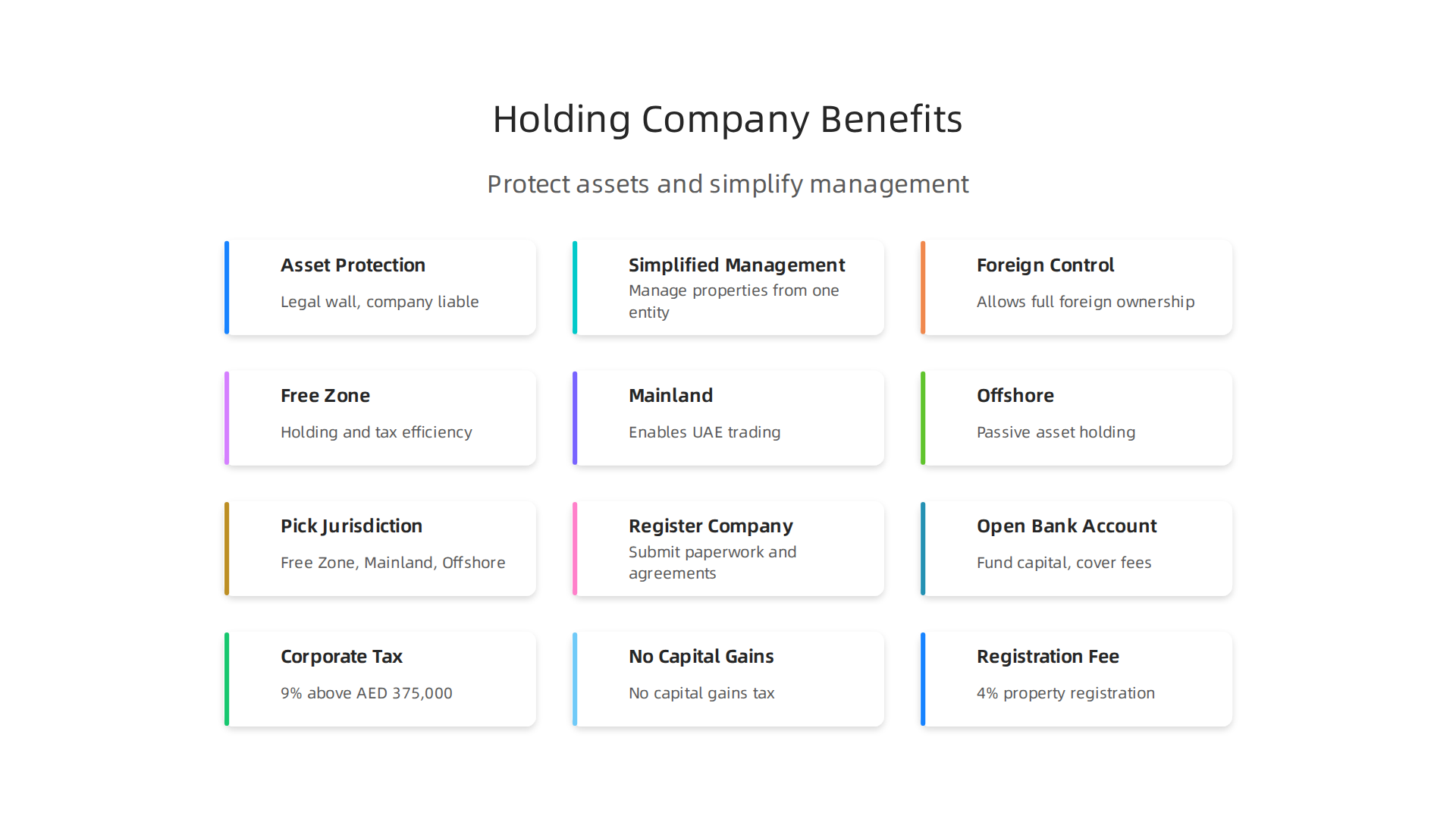
Privacy is another big benefit here. More buyers in 2026 care about keeping their ownership details private. A holding company gives you that layer of separation.
It makes managing your properties simple. If you own one property, managing it yourself is fine. But what happens when you own three, five, or ten properties? Things get messy fast. A holding company lets you run everything from one central place. You can sign an investment management agreement to handle tenants, maintenance, and rent collection. This setup makes asset management clean and easy. You are not juggling ten different ownership papers. You have one umbrella company that oversees everything. This structure makes it much easier to grow your portfolio over time.
It gives you full control as a foreign owner. Many investors worry about local ownership rules. But in Dubai, the rules are actually very investor friendly. In many free zones and prime areas, you can own 100% of your holding company as a foreigner. This means you have total control over your investments and your profits. The UAE corporate structure is built to welcome global capital. When you combine this with the strong returns available in the 2026 market, the logic becomes clear.
If you are ready to build a safer and more scalable investment plan, talking to an expert is the best next step. Book a Consultation to go over the right holding company setup for your portfolio. Or, if you have a quick question, Connect with Ayaz Salman on WhatsApp for a free chat. It is a small step that makes a big difference in how you grow your wealth in Dubai.
Key Corporate Structures Available
So you know why a holding company is a smart move. Now let’s look at the three main corporate structures you can choose from in Dubai. Each one works differently depending on your goals.
Free Zone companies are the most popular choice for foreign property investors. They offer 100% foreign ownership and great tax benefits. According to the Meydan Free Zone guide, these companies also enjoy tax exemptions but are limited to operating within the Free Zone and globally. This means you cannot do business directly inside the mainland UAE market unless you use a distributor. For holding property, this is rarely a problem. Most investment properties sit inside freehold areas, so a Free Zone holding company works perfectly.
Mainland companies let you trade anywhere in the UAE. That is the big advantage. But there is a catch. As of 2026, mainland companies may still require a local partner holding 51% of shares in certain activities. Some recent reforms changed this for many sectors, but for property holding, you need to check the latest rules. Mainland is best if you plan to run an active real estate business like a brokerage or property management firm.
Offshore companies are a different animal. They have no physical presence in Dubai. You register them to hold assets like property or bank accounts. They have fewer compliance requirements, which makes them simple. But they may not qualify for Dubai visa sponsorship if that matters to you.
Here is a quick comparison to help you decide.
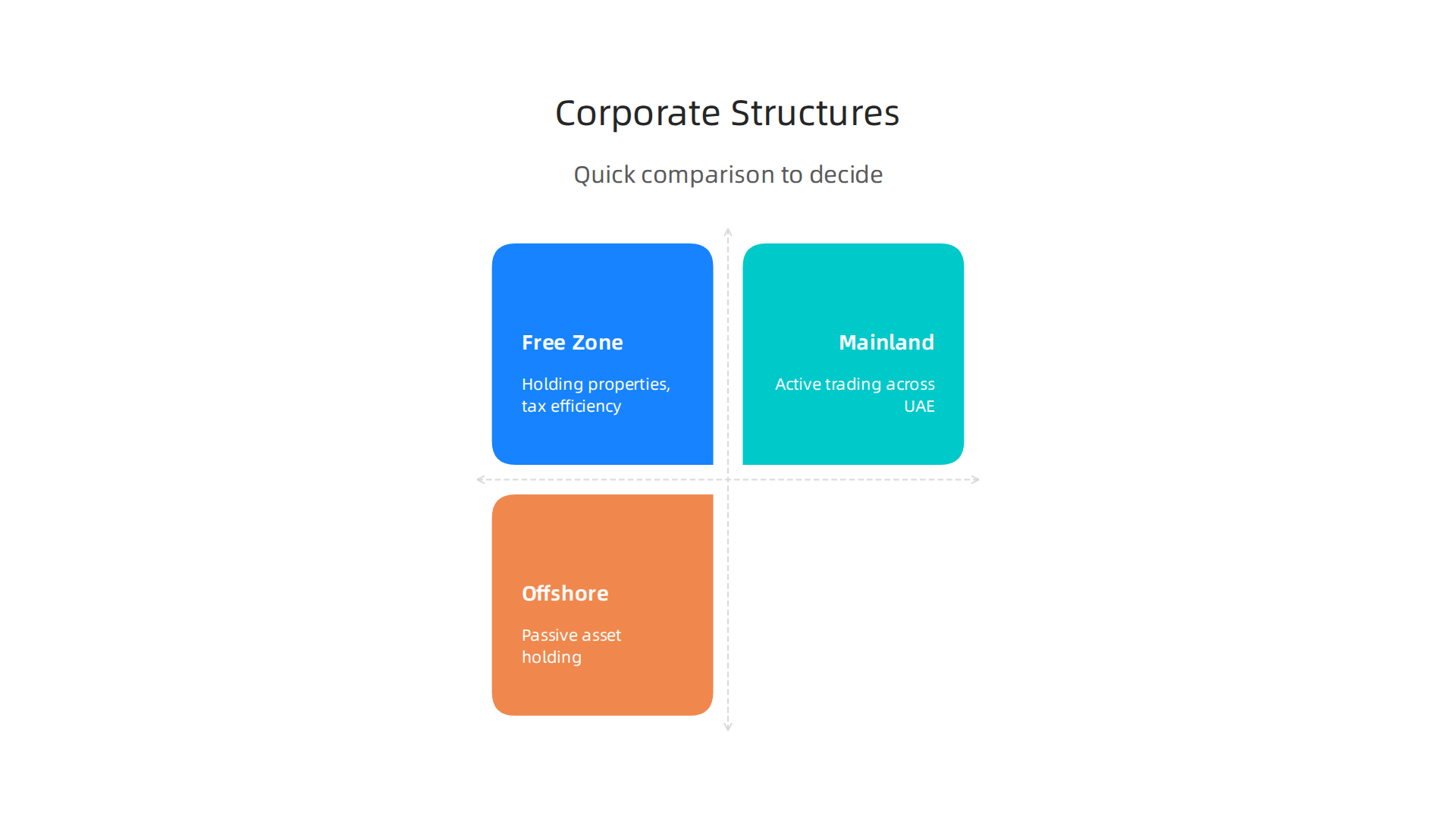
| Structure | Best For | Foreign Ownership | Where Can You Do Business |
|---|---|---|---|
| Free Zone | Holding properties, tax efficiency | 100% | Free Zone and globally |
| Mainland | Active trading across UAE | Usually 100% after reforms | Anywhere in UAE |
| Offshore | Passive asset holding | 100% | Outside UAE only |
Each structure has a role in smart asset management. The right choice depends on how you want to manage your properties and whether you plan to grow your portfolio. If you are unsure which one fits your plans, it helps to talk through your situation. Book a Consultation and we can match your goals to the best structure. No pressure, just clear advice on how to invest in Dubai real estate the right way in 2026.
Free Zone vs Mainland vs Offshore
Now that you know the basics from the table above, let’s talk about the real deciding factors. How do you actually pick one structure over the others? It comes down to how active you want to be and how much privacy you need.
Free Zone companies are the best fit for passive investors. If your plan is to buy and hold rental properties for the long term, this is your sweet spot. You keep 100% ownership and enjoy all the tax benefits. As the Meydan Free Zone guide explains, you operate within the Free Zone and globally. This makes Free Zone the most popular choice for setting up holding companies focused on steady asset management.
Mainland companies are for investors who want an active local business. Maybe you plan to open a brokerage or a property management team. A mainland license lets you trade directly anywhere in the UAE. Recent reforms in 2021 removed the old 51% local partner rule for many sectors, making it much more foreign-friendly. This is a strong option if you want full control over a local operation.
Offshore companies are the quietest option. They are built for privacy and holding assets outside the UAE. They have fewer compliance requirements and no physical office needed. But they are not for trading. And you cannot get a UAE visa through them.
Here is the simple way to think about it: Free Zone is for holding, Mainland is for trading, and Offshore is for privacy.

If you are still comparing your options and want to know which structure fits your personal plan to invest in Dubai real estate, talking it through helps. Connect with Ayaz Salman on Whatsapp and get honest, straightforward advice for your specific situation.
Limited Liability Company vs SPV
Once you decide on a Free Zone setup for your holding company, the next choice is the legal structure. The two most common options are a Limited Liability Company (LLC) and a Special Purpose Vehicle (SPV).
An LLC is a flexible choice for holding companies. It gives you limited liability, meaning your personal assets stay separate from the company’s debts. This works well if you plan to buy and manage several properties over time. An LLC serves as your main vehicle for ongoing asset management and can hold multiple investments under one roof. As the Meydan Free Zone guide explains, this structure offers 100% foreign ownership inside the Free Zone, which suits long term holding strategies.
A Special Purpose Vehicle (SPV) is different. You create an SPV for a single property or a specific deal. Its main job is to isolate risk. If something goes wrong with that one asset, the SPV protects your other investments from being affected. An SPV is ideal if you want a clean exit strategy later. You can sell the SPV shares instead of transferring the property title. This is common when you invest in Dubai real estate through a fund or with partners who have their own investment management agreement.
So which one fits your plan? It really comes down to your portfolio scale. An LLC is better if you want to grow a large collection of properties. An SPV is smarter if you want to keep each acquisition separate for safety and easy transfers.
Still unsure which structure works best for your next property deal? Connect with Ayaz Salman on Whatsapp and get personal advice that matches your goals.
Legal Steps to Set Up Your Holding Company
You picked your structure. Now make it official. The legal setup follows three clear steps, and getting them right protects your asset management goals.
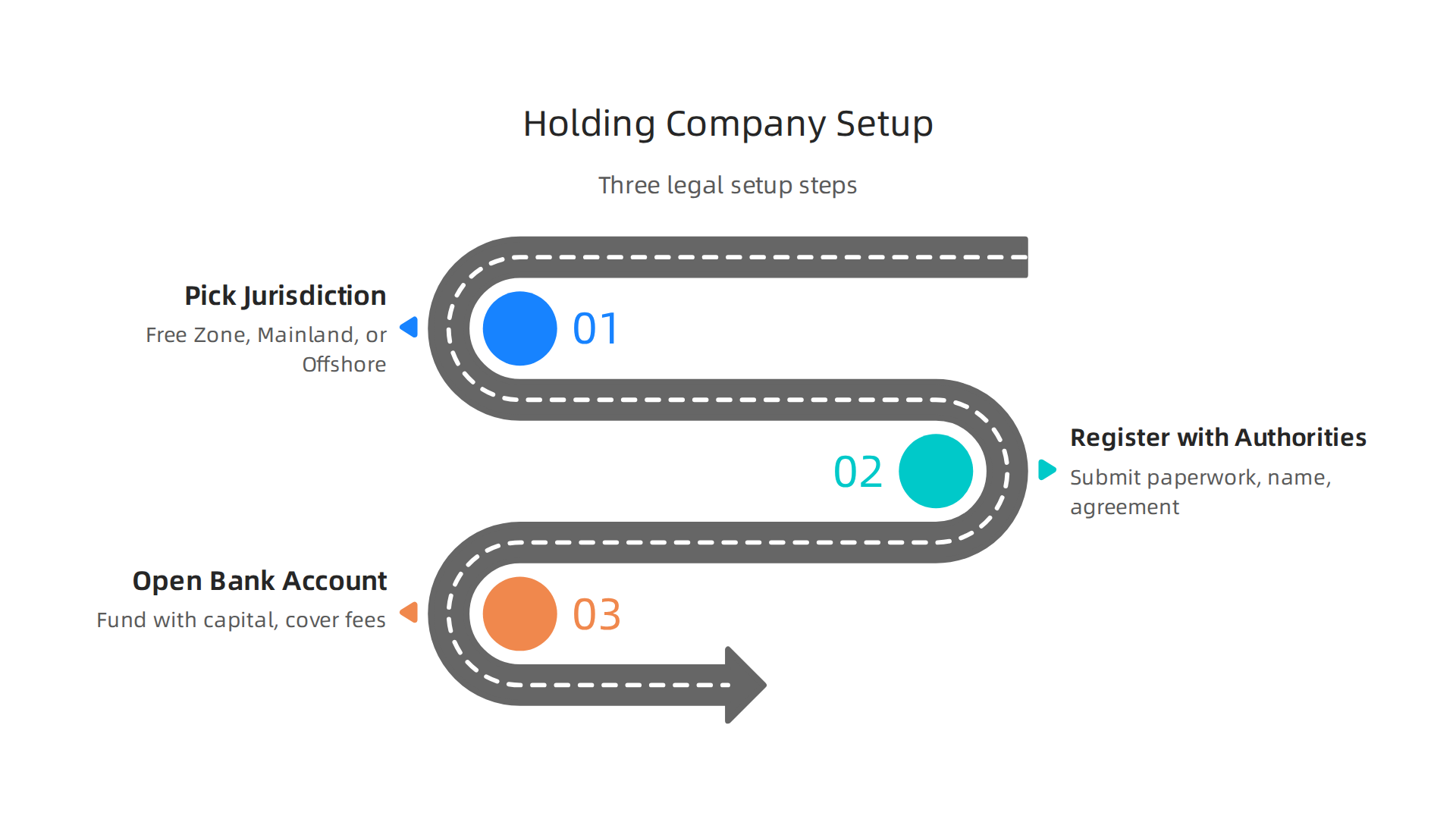
Step 1: Pick Your Jurisdiction
Your company needs a home. Will it be Free Zone, Mainland, or Offshore?
- Free Zone (JAFZA, DMCC): Best if you want 100% ownership and a straightforward way to invest in Dubai real estate.
- Mainland: Offers full access to the local market but requires a local partner in some cases.
- Offshore: Great for asset protection but rarely used for buying local property directly.
As the RFZ guide on starting a holding company explains, this choice sets everything else in motion. Most people starting their dubai invest journey choose a Free Zone for its simplicity and tax benefits.
Step 2: Register with the Authorities
Once you choose the jurisdiction, you submit the paperwork.
- Reserve your company name.
- Draft an investment management agreement if you are bringing in partners.
- Submit your application to the DED, DMCC, or JAFZA.
The E-StartupIndia guide breaks this down into a complete checklist. This brings your holding companies to life.
Step 3: Open a Bank Account and Fund It
You need a corporate bank account to buy property or manage assets.
- Capital Requirements: Many Free Zones allow low starting capital, sometimes as low as AED 10,000.
- Setup Costs: According to the Engel & Völkers company registration guide, expect total fees to start around AED 9,000 to AED 12,000 depending on the jurisdiction.
Getting this legal foundation right saves you from big problems later. If you want help with the paperwork and want to make sure your plan is solid, Book a Consultation to go over every step.
Registration and Licensing Requirements
Now that you have chosen your jurisdiction, it is time to gather your documents and pay the fees. This part is straightforward if you stay organized.
What You Will Need
Every application requires a standard set of paperwork. According to the E-StartupIndia guide on setting up a holding company in Dubai, you typically need:
- Passport copies of all shareholders and directors.
- A detailed business plan explaining your asset management goals.
- Proof of your residential address (like a utility bill).
Some Free Zones also ask for a draft investment management agreement if you plan to bring in partners.
Licensing Fees and Packages
Fees are not the same everywhere. The good news is that many jurisdictions now offer all-in-one packages. As the Engel & Völkers company registration guide notes, minimum fees usually start at AED 9,000 to AED 12,000. This covers your license and basic setup but often excludes visas and office space.
Special Approvals
If your holding companies will hold real estate directly, you may need approvals from the Real Estate Regulatory Authority (RERA). This is common when you plan to invest in Dubai real estate through your structure. A quick call with a registration expert can tell you if this applies to your case.
The process sounds like a lot, but it moves fast once you have your papers ready. If you want a step by step walkthrough, Connect with Ayaz Salman on Whatsapp for a free consultation.
Shareholder and Director Considerations
Once you finish the registration paperwork, you need to decide who will own and run your holding company. This part is simple if you know the basic rules.
Minimum Shareholder Requirements
Different structures have different rules. For example, a free zone holding company often needs only one shareholder. A mainland setup might require two. You can check the specific requirements for your chosen jurisdiction with a local setup expert. According to the RSN Finance guide on holding companies in UAE, the exact number depends on the legal form you choose.
No Bearer Shares
Here is a key point. The UAE does not allow bearer shares. All shares must be registered under a real person or company. This keeps your ownership clear and above board. If you plan to bring in silent partners, make sure every share is properly recorded.
Nominee Director Services
Some investors prefer to stay private. If that sounds like you, you can use a nominee director service. This is common for offshore holding companies. A nominee director acts on paper while you still control the company from behind the scenes. Many free zones and offshore jurisdictions in Dubai offer this option. The RFZ article on how to start a holding company in Dubai mentions that offshore structures are popular for this reason.
Bringing It Together
Your shareholder and director setup should match your asset management goals. If you plan to invest in Dubai real estate through your holding companies, you may need a structure that allows easy ownership transfers. A clear setup now saves headaches later.
Not sure which structure fits your dubai invest plan? Book a Consultation to get personalized advice on your shareholder and director arrangement.
Tax Implications and Structuring for Efficiency
You just set up your shareholder and director structure. Now comes the part that can save you real money. Understanding how taxes work for your holding company in the UAE is actually simpler than you might think. And the good news? The numbers often work in your favor.
The 9% Corporate Tax Rule
Here is the big change to know. Since June 2023, the UAE introduced a 9% corporate tax. But here is the catch. It only applies to profits above AED 375,000.
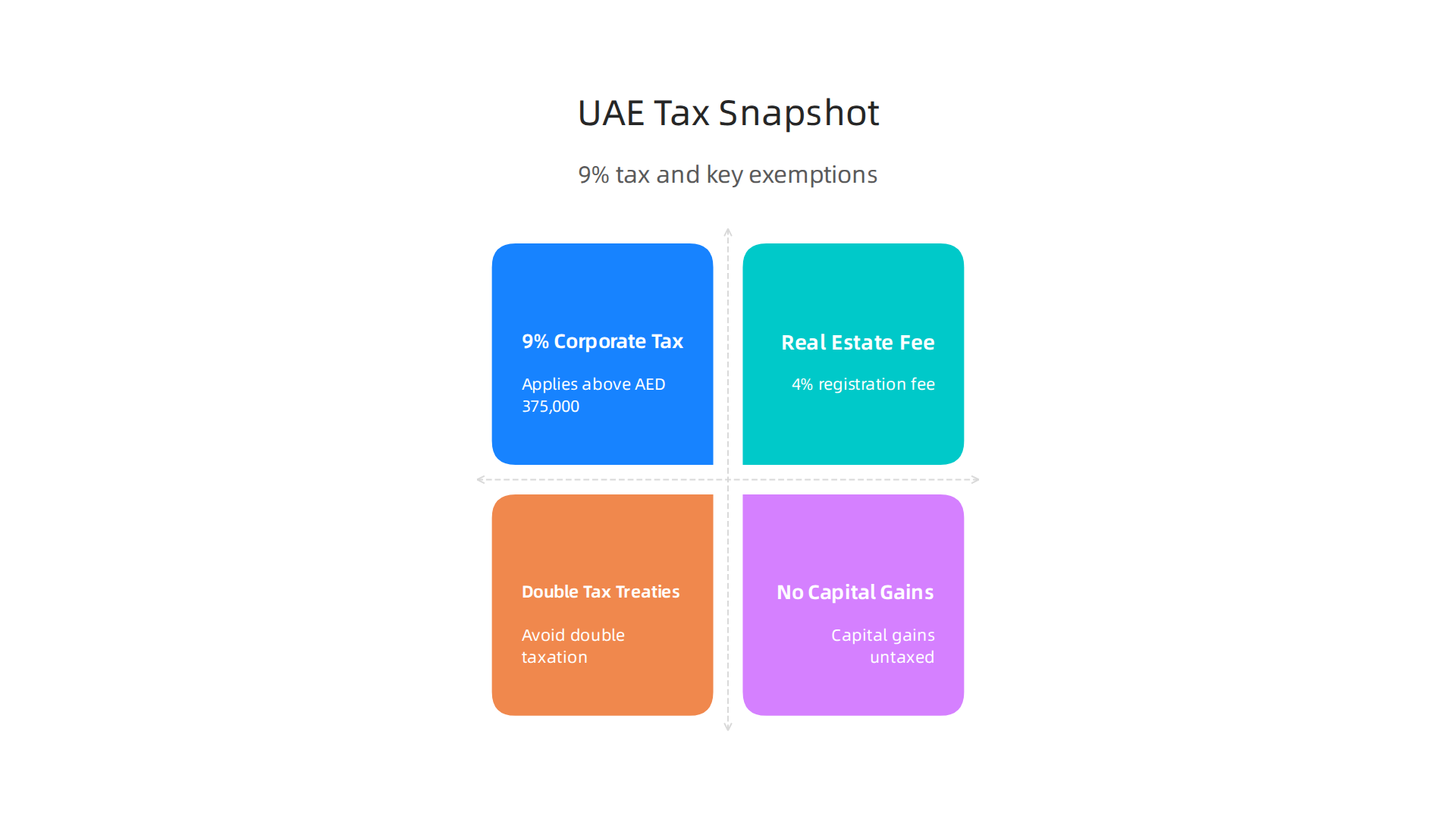
So if your holding company earns less than that, you pay zero corporate tax. A properly structured holding company can qualify for exemptions on dividends and capital gains too. According to The Key Advisory’s 2026 guide on UAE holding company setup, many holding companies can legitimately aim for a 0% effective tax rate with the right structure.
Real Estate Registration Fees
If you plan to invest in Dubai real estate through your holding companies, remember this cost. Every property transfer comes with a 4% registration fee based on the property value. This applies whether you buy through a holding company or personally. So factor that into your asset management budget. The Alvarez & Marsal overview of UAE real estate tax considerations confirms this standard fee applies across the board.
Double Taxation Treaties
Here is where holding companies really shine. The UAE has signed over 140 double taxation treaties. This means if your holding company earns income from another country, you avoid paying tax twice on that same money. For a dubai invest strategy involving international assets, this is a massive benefit.
No Capital Gains Tax
One of the biggest advantages of the UAE tax system is simple. There is no capital gains tax. So when your holding company sells a property or an investment at a profit, you keep every dirham. The Flying Colour Tax guide on holding company exemptions explains how this interacts with the new corporate tax rules.
Small Business Relief for 2026
Heads up. There is a temporary relief available until December 31, 2026. Small businesses can elect to be treated under a simplified tax regime. The PwC tax summary for the UAE notes this relief is available for tax resident persons who meet the criteria. If your holding company is new or small, this could reduce your compliance burden.
Setting Up Your Structure Wisely
The way you structure your holding companies directly affects your tax outcome. Free zone entities that meet Qualifying Free Zone Person (QFZP) tests can benefit from 0% tax on qualifying income. The Gulf Capital Intelligence QFZP guide for 2026 breaks down the requirements for this status. Pair this with an investment management agreement that clearly defines your holding company’s activities.
Your Next Step
Tax rules change. Structuring matters. And every investor’s situation is different. Connect with Ayaz Salman on Whatsapp for a free consultation about your specific tax situation and how to structure your holding company for maximum efficiency.
Risk Mitigation and Asset Protection
You have set up your holding company and sorted out the tax side. Now let us talk about keeping your money safe. That is one of the main reasons smart investors use holding companies in the first place.
How a Holding Company Shields You
Here is the simple truth. If you own a property in your own name and something goes wrong say a tenant gets hurt on the stairs you could lose more than just that property. Your personal savings, your other investments, everything could be at risk. But when you hold that property under a holding company, the liability stays inside the company. Your personal assets are walled off.

It is like having a fire wall between your business and your personal life. This protection is one of the biggest benefits of using holding companies for real estate, and the UAE corporate tax rules actually support this structure by offering exemptions on qualifying income, as explained in this guide on holding company exemptions.
Off-Plan Risks and How to Avoid Them
Buying off plan can be exciting. But it comes with real risk. What if the developer delays or worse stops building? You can reduce that danger with two simple steps. First, always make sure the developer uses an escrow account. That way your money is released only as the construction hits milestones. Second, do your homework. Look at the developer’s past projects and reputation. A solid investment management agreement also helps by clearly defining who does what. And remember, when you invest in Dubai real estate through holding companies, you add an extra layer of separation between yourself and any project trouble.
Insurance as a Safety Net
Even with a holding company, you want insurance. Get property insurance to cover damage to the building and liability insurance for accidents on the property. This is just smart asset management. It costs a little but can save you a fortune.
Your Next Move
Protecting your wealth is not complicated, but it does take planning. If you want to make sure your dubai invest strategy has the right safeguards, you do not have to figure it out alone.
Book a Consultation to talk through your options and build a protection plan that fits your goals.
Off-Plan Property Risks
You already know that holding companies can protect your assets. But what about risks that happen before you even own the property? Off plan buying is popular when you invest in Dubai real estate. But it comes with two big dangers: construction delays and developer insolvency.
Here is the good news. Dubai has strong rules to protect you. Since 2007, every off plan project must use an escrow account. The UAE escrow law makes sure your money goes only to the project, not into the developer’s pocket. Payments are released only when real construction progress happens. This is a huge safety net for anyone who wants to invest in Dubai real estate off plan.
But you still need to do your homework. Check the developer’s track record. Have they delivered projects on time before? Look at past projects. Talk to other buyers. A good investment management agreement can also spell out what happens if delays occur.
When you buy through holding companies, you add even more protection. Your asset management structure keeps the risk separate from your personal finances. So if a project hits trouble, your other investments stay safe.
Want to find off plan projects with strong developers and the right protections? Let us help you research.
Connect with Ayaz Salman on Whatsapp to talk about your next dubai invest move.
Insurance and Legal Safeguards
Beyond escrow accounts, there are other important layers of protection you should know about when you invest in Dubai real estate through holding companies. These safeguards cover both your physical asset and the people running the structure.
First, let us talk about insurance. You need property insurance to protect the building itself from fire, flood, or other damage. Public liability insurance covers you if a tenant or visitor gets hurt on the property. And if you have a holding company, director’s insurance is smart. It protects the company’s directors from personal lawsuits if something goes wrong.
Now for legal safeguards. The most basic is the title deed. It proves you own the property. When you buy through holding companies, the title deed is held under the company name, which keeps your personal name off public records. You also need a no-objection certificate (NOC) from the developer before selling or renovating a unit. Missing this step can stop a sale.
Your investment management agreement should include an arbitration clause. This means if a dispute happens, you go to a private arbitrator instead of court. It is faster, cheaper, and more private. Dubai’s legal system supports arbitration, which is a big plus for anyone using asset management through a holding company.
These protections work together. Escrow accounts, insurance, and strong contracts create a safety net for your dubai invest journey.
Want to make sure your holding company has the right insurance and legal paperwork? Let us help you set it up.
Book a Consultation to review your structure.
Long-Term Wealth and Exit Planning
You have set up your holding company, bought the property, and put all the right safeguards in place. Now let us talk about the endgame. How do you turn your investment into real long-term wealth? And how do you exit when the time is right?
When you invest in Dubai real estate through holding companies, you have more than one way to cash out. The simplest path is selling the property itself. The holding company sells the asset, and the profit stays within the company structure. But you can also transfer shares in the holding company to a buyer. This is often faster and avoids certain transfer fees. A third option is to liquidate the holding company entirely and distribute the assets. Each path has different tax and legal implications, so it pays to plan ahead.
Now let us talk about estate planning. This is a big deal. The UAE has no inheritance tax. That is a huge advantage for anyone using holding companies to hold property.

When you pass away, your shares in the company can pass directly to your heirs without a heavy tax bill. This makes succession much smoother than in many other countries. Your investment management agreement should already include instructions for how this works. Good asset management means thinking about the next generation, not just the next quarter.
Timing the market matters too. Dubai real estate moves in cycles. Capital appreciation is strongest when you buy early in a growth phase and sell at the peak. If you own an off-plan property, you need to understand the Dubai Land Department rules around completing the sale. Dubai’s escrow law ensures your payments are protected until the project finishes. This makes the exit process cleaner and safer for anyone who chose to dubai invest through a holding company.
Want to talk through your exit plan? Let us find the strategy that fits your goals.
Connect with Ayaz Salman on Whatsapp
So there you have it. You have walked through the whole journey from setting up a holding company to planning your exit. Now it is time to bring it all together.
Holding companies offer real legal, tax, and risk benefits when you invest in Dubai real estate. They protect your personal assets, give you more control over your investment management agreement, and make estate planning simpler. The UAE’s zero inheritance tax is a huge bonus for passing property to the next generation. And with strong asset management practices, you can keep everything running smoothly year after year.
But here is the thing. Every investor’s situation is different. The right structure for you depends on your goals, your budget, and how you plan to use the property. That is why professional advice matters. A local expert can help you choose the best holding company setup and make sure you follow all the rules.
Dubai’s property market is built on transparency and safety. As of 2026, every off-plan project must have an escrow account regulated by Law No. 8 of 2007, ensuring your payments are protected until completion. This added layer of security makes it easier to trust the process when you decide to dubai invest.
Start with a clear strategy. Then talk to professionals who know the market inside and out. That is the smartest path to building long-term wealth.
Ready to take the next step? Book a Consultation and let a local expert help you build your Dubai real estate plan today.
Summary
This article explains how using a holding company can improve your Dubai real estate investments in 2026 by offering liability protection, privacy, simpler asset management, and tax efficiency. It surveys the main corporate options—Free Zone, Mainland and Offshore—and compares LLCs versus SPVs so you can match structure to your goals. The guide walks through the legal steps to register, required documents, typical fees and bank setup, plus shareholder and director considerations such as nominee services. It outlines the UAE tax landscape, including the 9% corporate tax threshold (profits above AED 375,000), exemptions, no capital gains tax and common registration fees like the 4% property transfer levy. You’ll also learn practical risk controls—escrow protection for off‑plan purchases, insurance, and contractual clauses—and how to plan exits or succession through share transfers. The article stresses that the right structure depends on your objectives and encourages consulting a local expert to tailor the holding company for your portfolio.