
ICICI Bank Wealth Management Simplifies Your Dubai Property Investment

Introduction: Unlocking Dubai’s Property Market with Global Banking Expertise
The UAE real estate market keeps drawing investors from around the world. High rental yields, tax advantages, and a stable economy make Dubai a top choice for property buyers. But here is the honest truth: buying property in a foreign country is not simple. You need to understand foreign regulations, secure financing, handle currency exchange, and plan for taxes. Many high-net-worth individuals and expats struggle to find one trusted partner that combines global banking services with deep knowledge of the local real estate market.

That is where ICICI Bank wealth management comes in. ICICI Bank offers a range of services designed for NRIs and global investors who want a smooth entry into the Dubai property market. The bank provides dedicated relationship managers, personalized investment solutions, and specialized accounts that help manage your money across borders. For example, through the Wealth Management Savings Account, you get access to bespoke banking and premium privileges tailored to your financial goals.
This article will walk you through how ICICI Bank wealth management simplifies your Dubai property journey. You will learn about the specific services available, the rules you need to know, and the strategic planning involved. Whether you are a first-time investor or a seasoned buyer, understanding how to use global banking expertise can unlock better opportunities.
If you want a deeper look at how private wealth management connects to Dubai real estate, check out our guide on how private wealth management helps you invest in Dubai property. It covers the key steps and advantages of working with a wealth manager.
Ready to take the next step? FREE Dubai Real Estate Consultation – whether you are buying, selling, renting, or investing in Dubai, connect with Ayaz Salman for a free, no-obligation chat. Simply click here to start the conversation and get personalized advice.
Understanding ICICI Bank Wealth Management: Services for the Global Investor
So you have decided to invest in Dubai property. Now comes the real question: how do you actually move your money across borders, manage different currencies, and find the right property without getting lost in paperwork? That is where ICICI Bank wealth management steps in to bridge the gap.
ICICI Bank does not just offer standard banking. Its wealth management arm provides a complete suite of services designed specifically for global investors like you. Think of it as one stop for all your financial needs, from portfolio management to cross-border money transfers.
What You Get with ICICI Bank Wealth Management
The bank’s wealth management offering includes personalized investment planning, dedicated relationship managers, and access to exclusive products.
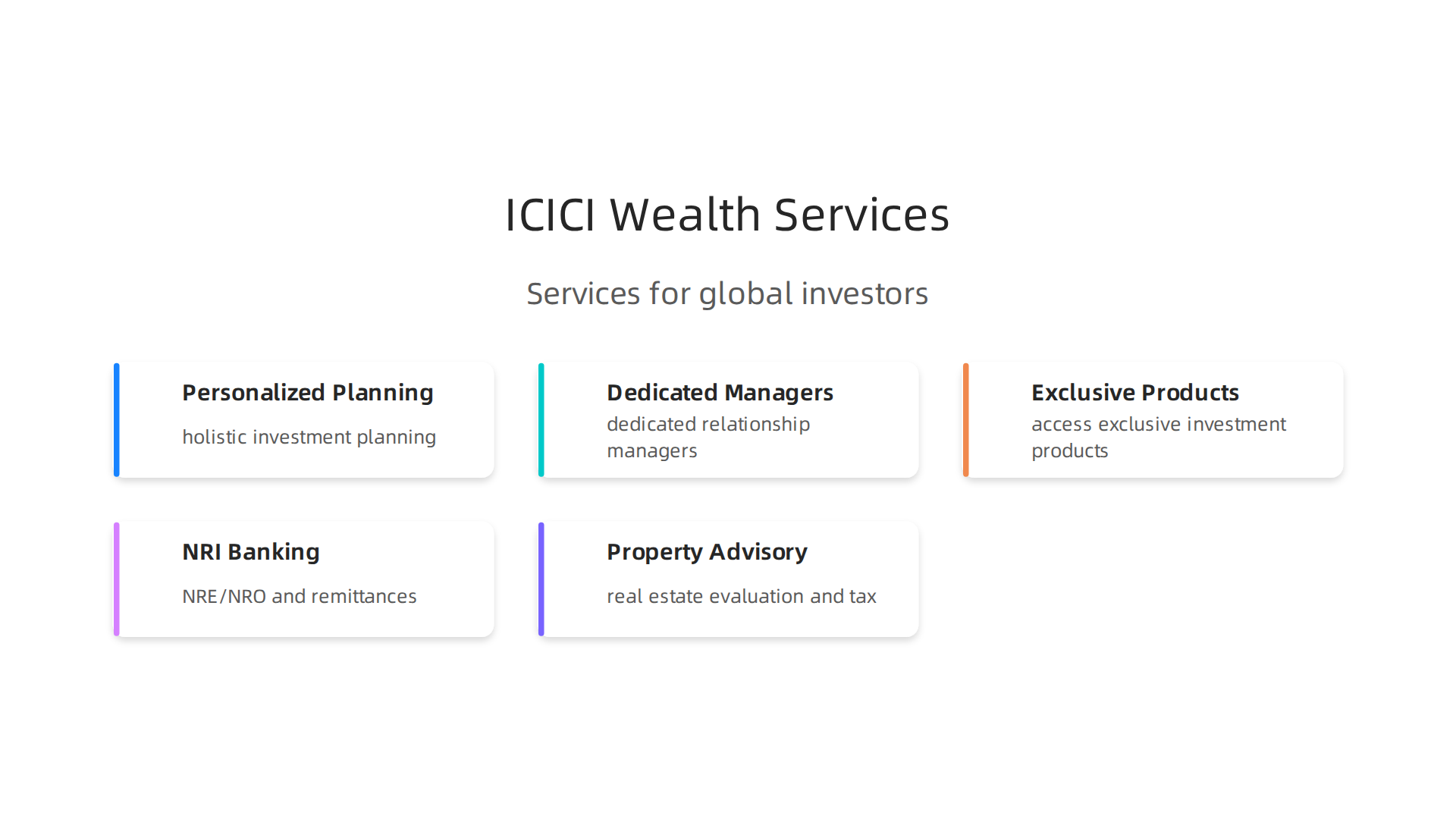
For example, through the platform at ICICI Direct Private Wealth Management, you can invest in equities, fixed income, alternative assets, and even offshore investments. This means you can build a portfolio that balances both your Dubai property goals and your overall wealth strategy.
But here is what really sets ICICI apart for Dubai investors: its strong NRI banking capabilities. With specialized NRE and NRO accounts, you can hold and repatriate your earnings in compliance with Indian regulations. The bank also offers currency management tools and international remittance services that make moving money between India, Dubai, and other countries smooth and cost effective.
How Property Investment Fits In
Unlike traditional wealth management providers such as wealth management Deutsche Bank, RBC wealth management online, or nuvama wealth management ltd, ICICI integrates property investment advisory directly into its wealth management framework. Your relationship manager does not just talk about stocks and bonds. They also help you evaluate Dubai real estate opportunities, understand financing options, and plan the tax implications of your investment.
This integration saves you time and reduces the risk of making decisions in isolation. Instead of juggling separate advisors for banking, investments, and property, you get a single point of contact who understands your full financial picture.
To see how this plays out in practice, check out our detailed guide on how ICICI wealth management simplifies your Dubai property investment. It walks you through the exact steps and benefits.
In short, ICICI Bank wealth management gives you the global banking expertise you need to enter the Dubai market with confidence. Whether you are an NRI sending money from the Gulf or a high-net-worth individual diversifying your portfolio, the services are built to make cross-border property investing feel local.
Key Offerings: NRE/NRO Accounts, Portfolio Management, and Advisory
So what does ICICI Bank wealth management actually offer that makes Dubai property investment feel doable from anywhere in the world? Three core services stand out.
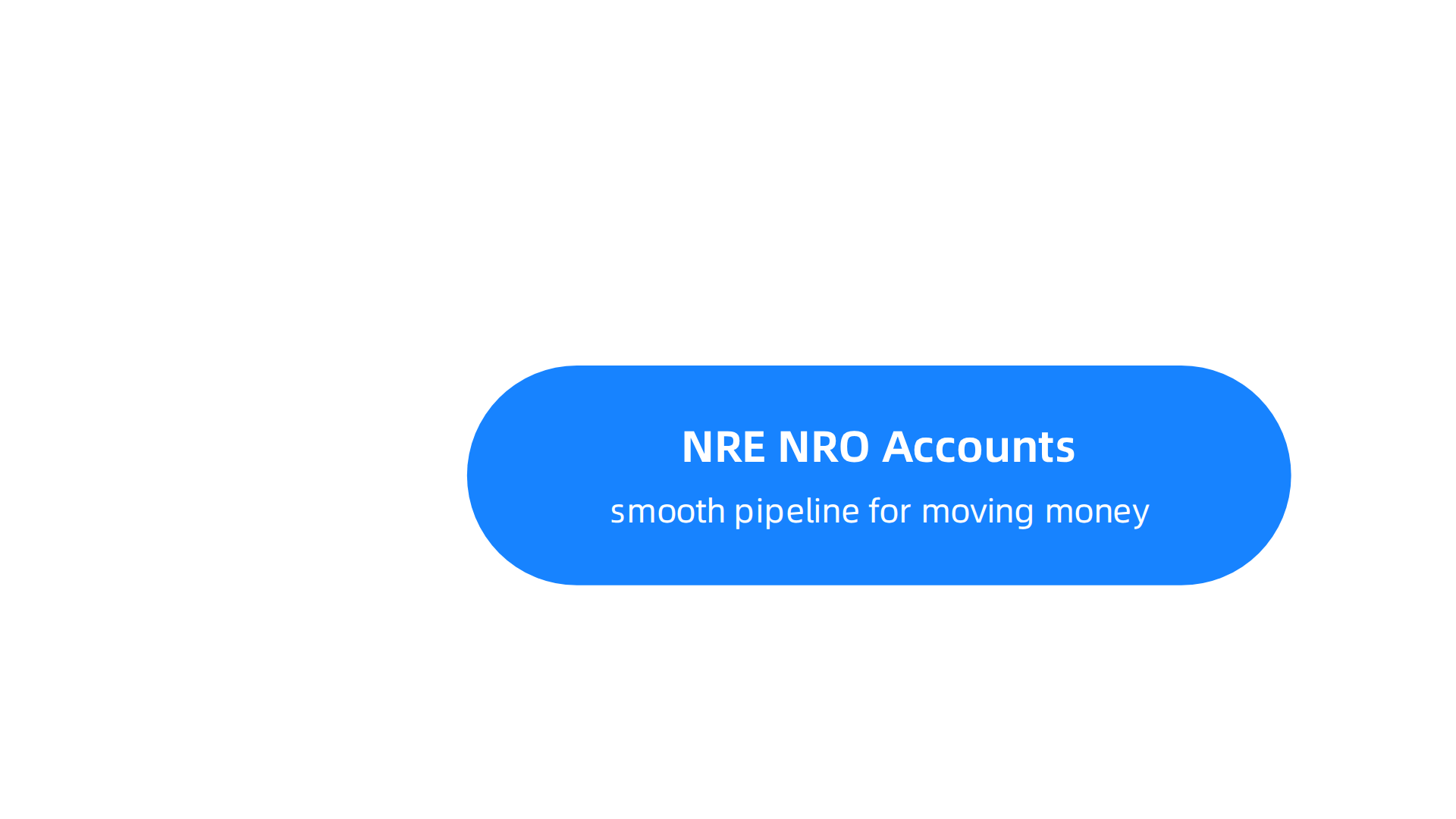
First, the NRE and NRO accounts. These are not just regular savings accounts. An NRE (Non-Resident External) account lets you hold your foreign earnings and move money freely between countries. You can send funds from your Dubai salary into this account, use them for property purchases, and repatriate both principal and interest anytime. An NRO (Non-Resident Ordinary) account handles income you earn in India, like rent from an existing property there. Together, they give you a smooth pipeline for moving money where you need it. For more on how these accounts work and their specific benefits, check out this guide on ICICI Bank NRI Account Opening in 2026.
Second, portfolio management through ICICI Direct Private Wealth Management. Your dedicated relationship manager does not just suggest stocks and bonds. They analyze Dubai real estate alongside other investments. They look at rental yields, market cycles, and capital appreciation trends. Then they give you research-backed recommendations on whether a Dubai apartment, villa, or off-plan project fits your overall portfolio. This holistic view is something you rarely get from a regular bank.
Third, value-added services that remove the guesswork. Estate planning helps you structure property ownership so your assets pass to your family without legal headaches. Tax advisory walks you through your obligations in India and the UAE, so you do not get surprised by a tax bill later. And legal liaison services connect you with local experts who handle title checks, sale agreements, and compliance documentation.
These three pillars work together as one system. Your NRE account holds the money. Your advisor guides the investment. And the support team clears the legal path. It is a complete setup for anyone looking at Dubai real estate without feeling lost in cross-border complexity.
To see how these services come together in a real investment plan, explore our guide on private wealth management for dubai property.
If you are ready to take the next step, reach out for a FREE Dubai Real Estate Consultation and get personalized advice on your investment strategy.
Why Dubai Real Estate Remains a Top Investment Choice for HNIs in 2026
Dubai’s property market keeps drawing high-net-worth individuals from across the globe in 2026. The numbers tell a clear story.
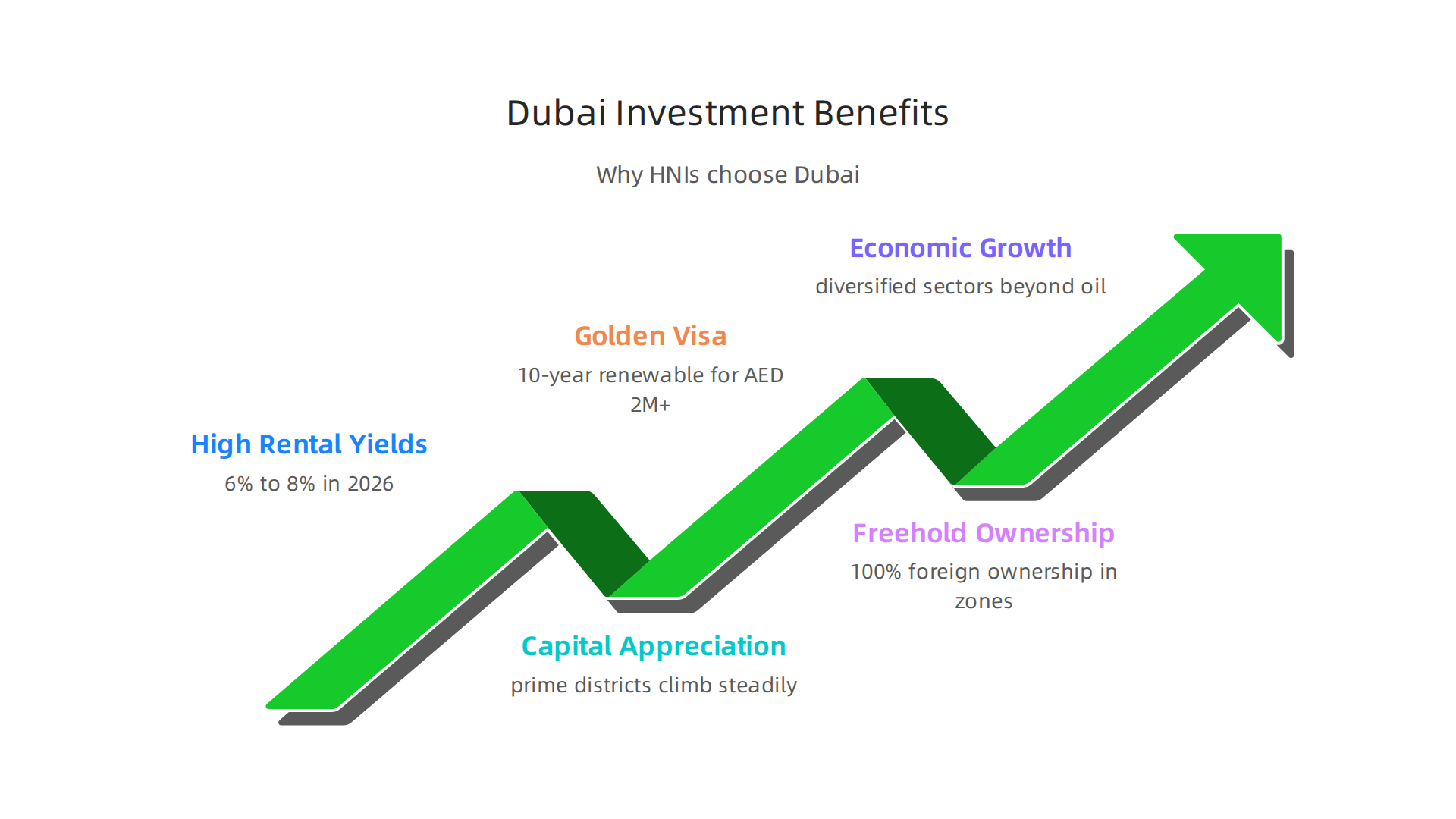
First, rental yields here are among the highest in the world. According to a recent report, average residential rental yields in Dubai range between 6% and 8% in 2026. Areas like Jumeirah Village Circle and Business Bay push even higher, offering gross yields of 7% to 9%. Established spots like Dubai Marina still deliver stable net returns of about 5.5% to 6.5%. Compare that to major cities like London, New York, or Singapore, where yields often stay between 3% and 5%. That gap makes a huge difference when you are investing larger sums.
Second, capital appreciation in prime districts continues strong. Dubai Marina, Downtown Dubai, and Palm Jumeirah have seen property values climb steadily. Demand from both local and international buyers keeps prices moving up. With over 120,000 new homes expected in Dubai in 2026, the supply is rising, but tenant demand remains high, keeping occupancy rates healthy.
Third, visa policies remove traditional barriers for foreign investors. Buying property worth AED 2 million or more qualifies you for a 10-year renewable Golden Visa. This long-term residency gives you stability and the freedom to live, work, and study in the UAE. You also get 100% foreign ownership in designated freehold areas with no need for a local partner. That makes the whole process simpler.
Fourth, the economic shift that started with Expo 2020 has turned into lasting growth. Dubai has diversified beyond oil into tourism, technology, and finance. These sectors are booming, creating a solid foundation for real estate investments.
All these factors make Dubai a top choice for HNIs in 2026. And when you pair that with strong ICICI bank wealth management support, you can build a strategy that captures high yields, steady appreciation, and tax advantages all at once. The combination is hard to find in any other market.
For a deeper look at how the numbers stack up, read this analysis on Dubai yields stay among world’s highest in 2026. And if you want to see how to apply these opportunities to your personal portfolio, explore our guide on wealth management for high net worth individuals in Dubai.
Navigating UAE Property Regulations: Legal Frameworks and Ownership Rules
Before you put any money into Dubai real estate, you need to understand the rules.
They are clearer than many expect, but you still need to get them right.
The first big choice is between freehold and leasehold ownership. Freehold gives you full ownership of the property and the land it sits on. You can sell it, rent it, or pass it to your heirs with no time limit. Leasehold gives you the right to use the property for a set period, usually up to 99 years. In Dubai, foreign investors can buy freehold property in designated freehold zones. As the government explains in its guide on expatriates buying property in the UAE, non-UAE nationals may acquire freehold ownership rights without restriction in these areas. Abu Dhabi now offers similar options since the 2019 law change that expanded foreign ownership to designated investment zones.
Two main bodies protect your investment. The Dubai Land Department (DLD) handles all property registration and title deeds. The Real Estate Regulatory Authority (RERA) sets the rules for developers and agents. They make sure everyone follows the law.
When you buy, especially an off-plan property, your money goes into an escrow account. This is a protected account managed by a bank. The developer can only withdraw funds as construction reaches specific milestones. That protects you from unfinished projects.
After signing, you pay a one-time transfer fee of about 4% of the property value to the DLD. You then receive a title deed that proves your ownership. The whole process is straightforward when you work with the right team.
For a full breakdown of the latest visa rules tied to property ownership in 2026, check this analysis on Dubai property investor visa rules. And if you want to understand how a professional can guide you through these regulations step by step, read our guide on how private wealth management helps you invest in Dubai property.
Getting the legal side right is the foundation of a successful investment. When you pair that knowledge with solid advice from an ICICI bank wealth management partner, you reduce risk and move forward with confidence. For personalized help navigating these rules, you can get a FREE Dubai Real Estate Consultation with an expert who knows the market inside out.
Financing Your Dubai Investment: Mortgage Solutions and Wealth Management Synergy
You have the legal side figured out. Now comes the money part. How do you actually pay for your Dubai property, especially when you live outside the UAE?

Here is the reality for non-residents in 2026. Banks in Dubai offer mortgages to foreign buyers, but the terms are different than for residents. According to a guide on Dubai Mortgages for Non-Residents, you can expect a loan-to-value ratio of 50 to 60 percent. That means you need a down payment of 40 to 50 percent of the property price. Interest rates for non-residents usually run from about 4.25 to 6.5 percent, depending on your profile and the bank. The maximum loan term is often 15 to 25 years.
Some lenders that accept non-resident applications include HSBC, First Abu Dhabi Bank, and Mashreq. Each bank sets its own rules. A detailed breakdown of mortgage eligibility and banks shows that you also need to meet a minimum monthly income, provide proof of employment, and submit bank statements from your home country.
This is where ICICI Bank wealth management comes into the picture. If you are an NRI or a global investor with ties to India, ICICI offers tools that make cross-border financing much smoother. You can use an NRE or NRO account to hold funds in Indian rupees or foreign currency, then transfer them to Dubai when you need to make a down payment or pay EMIs. The ICICI Bank wealth management savings account gives you a dedicated relationship manager who can help coordinate these transfers and connect you with the right mortgage partners.
Another smart move is the FCNR (Foreign Currency Non-Resident) deposit account. It lets you hold foreign currency and earn interest that is tax-free in India. You can use those funds as proof of assets when applying for a Dubai mortgage.
The synergy works like this. Your ICICI wealth manager reviews your full financial picture. They help you decide how much to keep in India and how much to move to Dubai. They also guide you on currency timing to avoid losing money on exchange rates. Then you enter the Dubai mortgage process with a clear down payment plan and a strong financial profile.
If you want a deeper look at how this all fits together, check out this complete guide on how wealth management ICICI simplifies your Dubai property investment in 2026. It walks through each step from account setup to final purchase.
Getting financing right takes the pressure off. When your bank accounts, currency transfers, and mortgage application all line up, you can move fast when you find the right property. That is the advantage of working with a wealth management partner who understands both the Indian banking system and the Dubai real estate market.
Tax Optimization for Global Investors: Dubai’s Advantages and Home Country Implications
One of the biggest reasons people buy property in Dubai is the tax deal. The UAE charges zero personal income tax on your rental earnings. And when you sell a residential property, there is no capital gains tax either. As one analysis of the 2026 market explains, the country offers no annual local property tax and no capital gains tax on residential sales. That alone saves you a huge amount compared to many other countries.
But here is the thing. Where you pay tax is not just about where the property sits. It is also about where you live. If you are an Indian resident, for example, India taxes your global income. That means your Dubai rental income and any profit from selling the property may be taxable back home. The same goes for residents of many other countries.
This is where Double Taxation Avoidance Agreements (DTAAs) come in. The UAE has a strong DTAA with India and many other nations. These treaties make sure you do not pay tax twice on the same income. You can claim a credit in your home country for taxes paid in the UAE. But since the UAE does not tax your rental income or capital gains, you may still owe tax in your home country depending on local laws.
So how do you handle this? A wealth manager who knows both the Dubai market and your home country tax rules can help you plan.

With ICICI Bank wealth management, you can coordinate how you hold funds and time your transfers. Your relationship manager can connect you with tax advisors who understand how DTAAs apply to property income. They can also help you choose the right account type to minimize tax exposure.
For example, keeping your Dubai rental income in an NRE account means it stays tax-free in India if you are an NRI. But if you are a resident, you need a different strategy. The key is to plan before you buy, not after.
For a deeper look at how global investors structure their tax approach, read this wealth management expert guide for 2026 investors. It covers the full picture from account setup to exit strategy.
Getting tax right is just as important as finding the right property. When you know what you will owe and what you will save, you can make smarter decisions. And if you want personalized advice on your specific situation, you can always connect with an experienced advisor.
FREE Dubai Real Estate Consultation
Mitigating Risks in Off-Plan and Secondary Market Properties
Buying property in Dubai comes with real risks. If you invest off-plan, you face developer delays or even project abandonment. In the secondary market, sudden price drops can hurt your returns. But you can reduce these risks with the right checks before you sign anything.
Start with a simple due diligence checklist. For off-plan properties, verify that the developer has registered the project with RERA. This is the Dubai Real Estate Regulatory Authority. Next, make sure your payments go into a regulated escrow account. This protects your money if the developer fails to deliver. Banks also reduce risk here. For non-residents buying off-plan, the maximum loan-to-value is capped at 50 percent. That means you put down a much larger deposit. The rules around loan-to-value (LTV) in Dubai explain exactly how this works for foreign buyers.
Next, check the developer’s track record. How many projects have they finished on time? Search for reviews from past buyers. Avoid developers with a history of delays or legal disputes. You can also look up the developer on the RERA website to confirm they are licensed.
For secondary market properties, get a professional valuation. Ask about the building’s maintenance history and service charges. Make sure the title deed is clean and has no disputes.
This is where professional support makes a real difference. A wealth management team runs thorough due diligence on every deal. They check the developer, the legal paperwork, and the current market conditions. They also bring in lawyers who specialize in Dubai property law. For example, you can learn more about how private wealth management helps you invest in Dubai property and the specific protections it provides.
When you combine escrow verification, developer background checks, and expert legal support, you lower your risk by a lot. You can invest with much more confidence.
Real Success Stories: How Global Investors Built Wealth with ICICI Wealth Management
Let’s look at two real examples of how ICICI Bank wealth management helped people succeed in Dubai property.
Case study 1: An NRI couple diversifying into Dubai rentals
A couple living abroad had most of their savings in Indian fixed deposits. They wanted better returns but did not want to take big risks. Their ICICI wealth manager explained the diversification case for Dubai property investors and showed them how rental income in Dubai could balance their portfolio. The advisor helped them pick two off-plan apartments in Dubai South. After completion, both units rented out quickly. Today the couple earns steady passive income and has reduced their overall risk by spreading their money across countries and asset types.
Case study 2: An HNI using estate planning for the next generation
A high net worth individual owned several Dubai villas worth over USD 3 million. He worried about how his children would manage these assets after he was gone. ICICI’s estate planning team created a family trust that holds the properties. The trust handles all legal paperwork and distributes rental income to his children. Now the wealth transfers smoothly without family conflict or tax surprises.
Expert insight from the industry
Wealth managers say the most successful investors share one habit: they work with a trusted advisor from the start.

They do not make isolated property deals. Instead they build a long term plan that covers diversification, tax strategy, and inheritance. This is exactly what ICICI Bank wealth management offers its clients across the world.
If you want to explore how ICICI can help you invest in Dubai property, start with a FREE Dubai Real Estate Consultation and speak to an expert who knows the market inside out.
Summary
This article explains how ICICI Bank wealth management helps NRIs and global investors enter the Dubai property market by combining cross‑border banking, tailored investment advice, and local real estate expertise. It outlines the bank’s key offerings — NRE/NRO/FCNR accounts, ICICI Direct Private Wealth portfolio management, dedicated relationship managers, and value‑added services like tax and estate planning — and shows how those services simplify currency transfers, mortgage preparation, and legal compliance. You’ll learn why Dubai remains attractive in 2026 (high rental yields, capital appreciation, visa incentives) and the practical steps for ownership, escrow protection, and typical mortgage terms for non‑residents. The piece also covers tax implications and DTAAs, risk mitigation for off‑plan and secondary buys, and two real case studies demonstrating diversification and estate planning. After reading, you should know which services to request from a wealth manager, how to structure payments and accounts, and when to get expert legal and tax help to move forward confidently.