
Wealth Management for Dubai Property Investors

Introduction
Have you ever heard the term "wealth management" and felt unsure what it really means? You are not alone. Many property investors, especially those new to Dubai, hear this phrase but struggle to understand how it applies to them.
So, what is wealth management exactly? At its core, it is an umbrella term for financial advice that helps you grow and protect your money. It covers investment planning, portfolio management, tax strategy, and more. Think of it as a big picture approach to your financial life.
For real estate investors in Dubai, understanding what is wealth management can make a huge difference.

Dubai’s property market offers high rental yields and strong growth opportunities. But navigating this market without a clear strategy is risky. That is where personal wealth management comes in.
A solid wealth plan helps you choose the right properties, manage risks, and plan for the long term. It moves beyond just buying a villa or an apartment. It looks at how each investment fits into your overall financial goals.
Modern wealth management is no longer just for the ultra-rich. More investors today use personalized wealth management to make smarter choices. They work with advisors who understand both local market conditions and global investment trends.
In this article, we will break down what is wealth management in simple terms. You will learn its core components and see how it applies directly to Dubai real estate. By the end, you will have a clear framework to evaluate your investment strategy.
If you are ready to take the next step with your Dubai property plans, you can get a FREE Dubai Real Estate Consultation with an expert who knows the market inside out.
Let us start by looking at how private wealth management works and why it matters for property investors like you.
What Is Wealth Management? A Definition for Property Investors
So what is wealth management, really? Buying a property in Dubai is exciting. But if you treat each purchase as a standalone deal, you might miss the bigger picture. Wealth management connects every investment decision to your long-term goals.
At its simplest, wealth management is an integrated approach to your financial life. It covers investment planning, tax strategy, estate planning, insurance, and risk management. A good wealth manager looks at your entire financial world. They do not just pick stocks or recommend a villa. They build a plan that ties everything together.
The CFA Institute, a global authority in finance, defines private wealth management as combining financial planning and investment management to help individual investors manage their wealth.

It includes personalized financial planning, tax advice, and estate planning. The goal is to maximize after-tax wealth while respecting the client’s goals, risk tolerance, and constraints. You can read more in the official Overview of Private Wealth Management from the CFA Institute.
That definition matters for property investors. Here is why. When you buy a rental apartment in Dubai Marina, you are not just buying four walls and a view. You are making a decision about your cash flow, your retirement timeline, your tax exposure, and your family’s future. Wealth management helps you see those connections.
For example, say you own two off-plan units and a ready villa. A wealth manager asks: How does each property fit your risk tolerance? Are you overexposed to one developer? Do you have enough liquidity for maintenance and vacancy periods? Are you using the right ownership structure to protect your assets?
This is where personal wealth management becomes practical for real estate investors. It turns scattered purchases into a coherent portfolio. It helps you decide whether to sell, hold, or reinvest based on your life stage, not just market rumors.
If you want a deeper look at how professional guidance works in Dubai, check out this guide on how private wealth management helps you invest in Dubai property. It shows how a structured approach protects your capital and grows your returns.
The key takeaway: wealth management is not a luxury for the ultra-rich. It is a framework that any serious investor can use to make smarter choices. In the next section, we will break down the core components that make up a solid wealth plan for Dubai property owners.
Now that you understand what wealth management is, let’s look at the engine that powers it: asset allocation. This is the single most important decision you will make as an investor. Getting it right protects your money. Getting it wrong can wipe out years of gains, even if you pick great properties.
Core Wealth Management Principles: Asset Allocation for Dubai Portfolios
Think of asset allocation as the blueprint for your investment portfolio. It decides how much of your money goes into different categories like stocks, bonds, real estate, and cash. Your mix of assets, not individual picks, drives most of your long-term returns. That is why modern wealth management starts here.
For Dubai property investors, asset allocation has two layers. First, you decide how much of your total wealth goes into real estate versus other assets. Second, you decide how to spread that real estate investment across different property types and locations.
What do wealthy investors actually do?
The 2026 Capgemini World Wealth Report surveyed 6,510 high-net-worth investors around the globe.

As of January 2026, the average HNWI portfolio looked like this: equities held 25%, fixed income held 20%, alternatives held 12%, and the remaining roughly 43% sat in cash and real estate combined. The full breakdown is available in the official World Wealth Report 2026 from Capgemini.
Notice that real estate is a meaningful slice but not the whole pie. Wealthy investors keep a balanced mix so that when one asset class struggles, another may perform well.
Applying this to your Dubai portfolio
What does this mean for you? If you already own two or three Dubai apartments, ask yourself: Are you overconcentrated in one submarket like Dubai Marina or Downtown? Is all your capital in off-plan units with no ready property generating cash flow?
A smart allocation within real estate might look like:
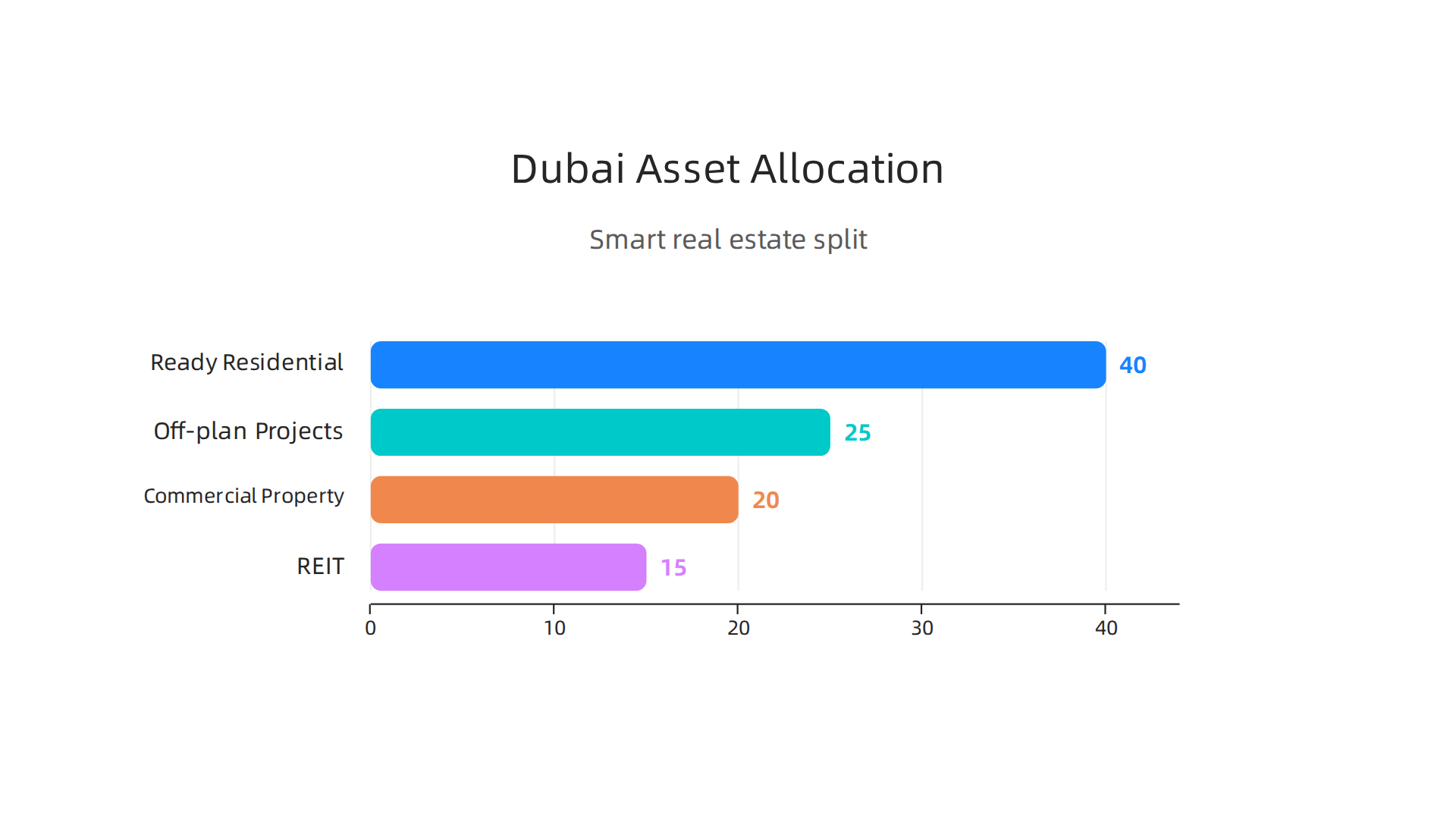
- 40% in ready residential units that produce rental income
- 25% in off-plan projects with capital growth potential
- 20% in commercial property (office or retail) for lease stability
- 15% in a real estate investment trust (REIT) for liquidity and diversification across geographies
This is where personalized wealth management becomes practical. Your age, income needs, and risk tolerance will shift those percentages. A younger investor might favor more off-plan exposure. Someone nearing retirement might prioritize cash-flowing ready units.
Why this matters right now
Dubai’s property market offers great returns, but it is cyclical. Spreading your bets within real estate and across different asset classes reduces your vulnerability to a downturn in any single sector. For a deeper look at how to structure your real estate allocation specifically for high-net-worth investors, check out this guide on Dubai real estate wealth management for high net worth investors 2026.
The bottom line: asset allocation is the bedrock of what is wealth management in practice. Without a clear plan for where your money sits, even the best Dubai villa can become a risky bet.
Ready to build a portfolio that matches your goals? Buying, selling, renting, or investing in Dubai? Connect with Ayaz Salman for FREE Dubai Real Estate Consultation. He can help you translate these principles into a plan that works for your situation.
Risk Management in Dubai Real Estate: Key Concepts for Wealth Preservation
A solid asset allocation plan is only half the battle. The other half is protecting what you have built. That is where risk management comes in. In the world of personal wealth management, risk management is the safety net that keeps your portfolio from falling apart when things go wrong.
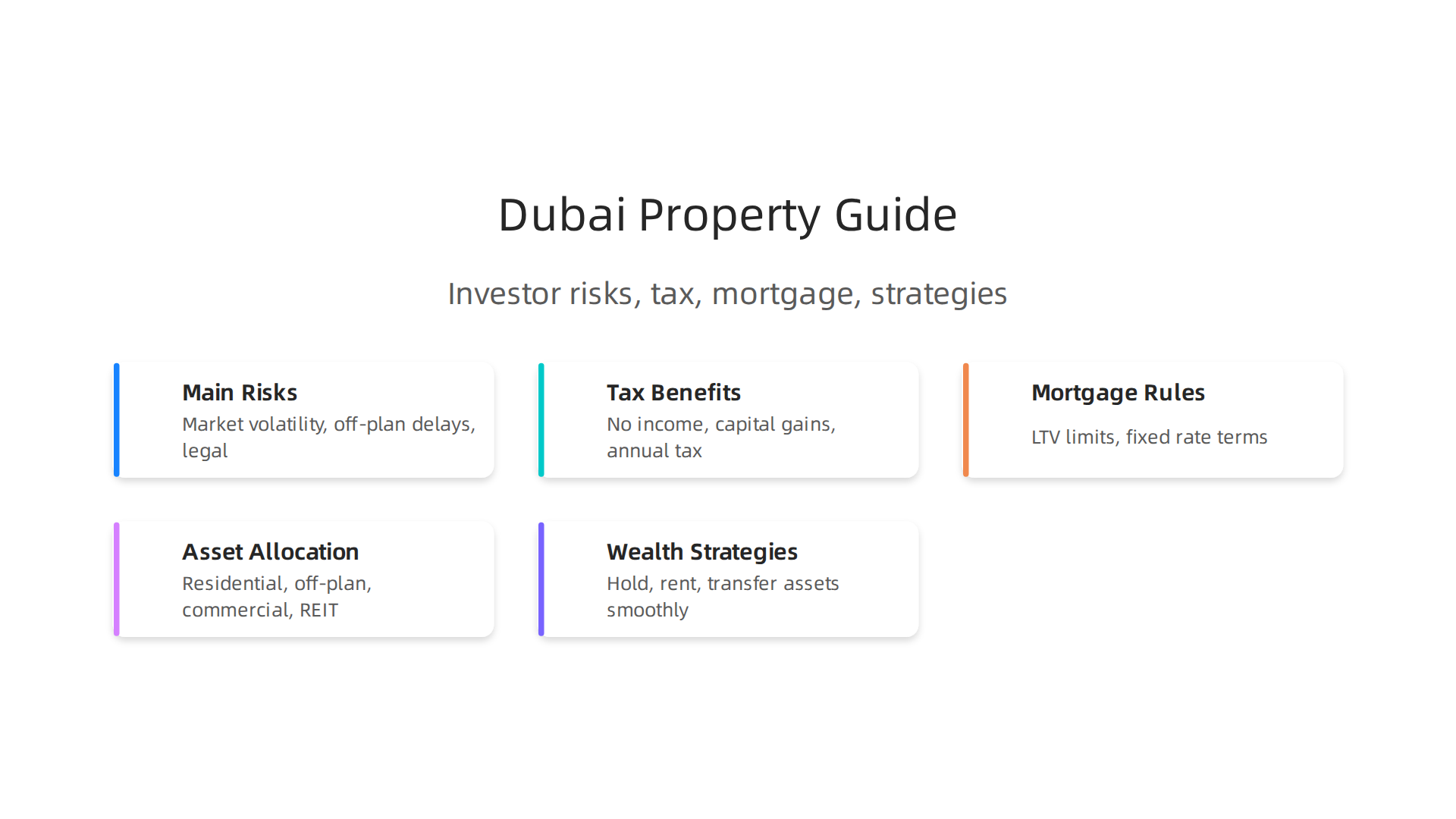
Dubai’s property market has many strengths. But it is not risk-free. If you ignore the risks, even a well-diversified portfolio can take a hit. Let’s look at the main risks you face as a Dubai property investor and what you can do about them.
The Biggest Risks for Dubai Property Investors
Market volatility. Property prices in Dubai can move up and down. In 2026, some analysts see early signs of weakness. A Reuters report notes that property prices could drop by an average of 7% annually between 2026 and 2028 in a bearish case.
You can read the full report on the early signs of weakness in Dubai’s property sector.
Off-plan delays and quality issues. When you buy off-plan, you are trusting the developer to finish on time and deliver a quality product. If they cut corners or face delays, your rental income and resale value can suffer. That is a real risk in any fast-growing market.
Currency fluctuations. If you earn income in one currency but your Dubai property is priced in dirhams, exchange rate changes can eat into your returns. A strong dirham can reduce the value of your rental income when converted back to your home currency.
Legal and regulatory changes. Dubai’s rules around property ownership, visas, and taxes can shift. While the government has been investor-friendly for years, no one can guarantee the future.
Tools That Protect Your Wealth
The good news is that modern wealth management offers tools to handle these risks.
Insurance. Property insurance protects against physical damage. But also consider loss of rental income insurance if your tenant stops paying.
Legal due diligence. Before you buy, check the developer’s track record. Look at their last three to five completed projects. Verify that your off-plan payments are held in an escrow account regulated by the Dubai Land Department and RERA. This keeps your money safe even if the developer runs into trouble.
Exit strategies. A smart investor always knows how they will sell. Plan your exit before you enter. Know which neighborhoods have strong resale liquidity and which properties are easier to sell in a downturn.
Risk-adjusted returns. This is the idea that higher risk should come with higher potential reward. A property in a speculative fringe area with a 10% gross yield may actually be worse than a core area with a 6% yield, because the risk of vacancy and price drop is lower. Always think in terms of what you keep after risk, not just what you earn on paper.
Putting It All Together
Risk management is not about avoiding risk completely. It is about understanding the risks you take and making sure you are paid fairly for them.

For a deeper look at how professional guidance can protect your investment, explore this guide on wealth management guidance that protects your investment.
This is a core part of what is wealth management for any serious investor. You can have great assets. But without risk management, you are one bad event away from losing years of progress.
Tax Implications and Wealth Management: The Dubai Advantage
Now let’s talk about one of the biggest reasons people invest in Dubai in the first place. The tax environment.
When you ask what is wealth management really about, a huge part of the answer is keeping more of what you earn. And that is exactly what Dubai’s tax system helps you do.
The Zero Tax Trifecta
Dubai offers something you will struggle to find anywhere else. Three major taxes that simply do not exist here.
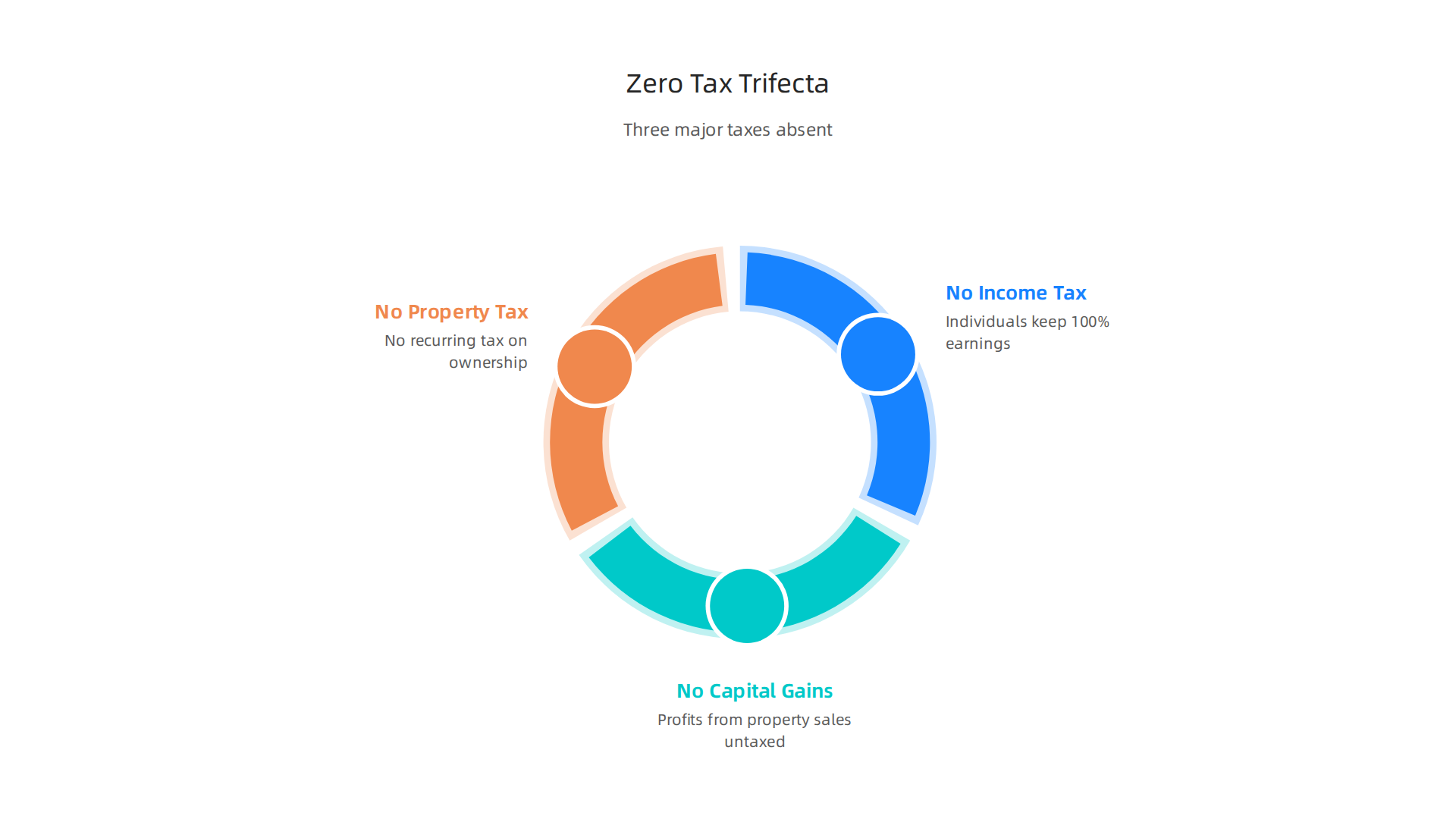
No personal income tax. Every dirham of rental income you earn is yours to keep. There is no tax authority taking a cut. In most global cities, rental income gets taxed at 20% to 40% or more. In Dubai, you keep 100 percent of it.
No capital gains tax. When you sell a property for a profit, that profit is not taxed. If you buy a villa for 2 million AED and sell it for 3 million AED five years later, the full 1 million AED gain is yours. A detailed breakdown of the property taxes, fees and costs in Dubai for 2026 confirms there is no separate capital gains tax for individual sellers of residential property.
No annual property tax. Unlike the US or UK where you pay 1% to 3% of your property value every single year, Dubai has no recurring property tax. Your only ongoing cost is the service charge for building maintenance, which is a fraction of what property taxes cost elsewhere.
What You Actually Do Pay
This does not mean there are zero costs. Here is what you will pay:
- DLD registration fee of 4% on purchase. This is a one-time fee, not an annual tax.
- VAT of 5% on service charges, agent commissions, and some property services. But residential property purchases themselves are usually VAT-exempt or zero-rated.
- Corporate tax of 9% if you hold your property through a company structure and your revenue exceeds 375,000 AED. Small property holding companies may qualify for 0% corporate tax under the Small Business Relief program.
The Home Country Warning
Here is the catch. Your home country might still want a piece of the pie.
If you are a US citizen, the IRS taxes your worldwide income. UK residents pay capital gains tax on overseas property sales. Indian residents must check their residency status carefully.
This is where personalized wealth management becomes essential. A good plan accounts for both Dubai’s zero tax rates and your home country’s tax rules so you do not get a nasty surprise at filing time.
Why This Matters for Your Returns
Think about it this way. A property yielding 7% gross rent in London might net you only 4% after taxes. The same property in Dubai yielding 7% keeps all 7%. Over ten years, that difference compounds into serious money.
For a deeper look at how to structure your investments for maximum tax efficiency, check out this guide on smart property investment through Dubai wealth management.
This is modern wealth management at its best. You build assets in a market that helps you keep them. And that is really the whole point.
If you want to talk through how Dubai’s tax advantages fit your specific situation, reach out for a FREE Dubai Real Estate Consultation. A quick conversation can save you thousands in unnecessary taxes down the road.
Financing and Mortgage Strategies in a Wealth Management Framework
When you ask what is wealth management really about, most people think picking the right asset matters most. That is true. But how you pay for that asset matters just as much.
Here is the thing. Borrowed money can turbocharge your gains. But it can also speed up your losses. That is why personal wealth management always includes a clear plan for debt. You borrow with purpose, not with hope.
How Leverage Works in Dubai Real Estate
Say you have 500,000 AED in cash. Without a mortgage you buy one property worth 500,000 AED. With a 50% loan to value mortgage you buy a property worth 1,000,000 AED. If that property goes up 10%, you make 100,000 AED on your 500,000 AED. That is a 20% return instead of 10%.
That is the power of leverage.
Flip it around. A 10% drop means you lose 100,000 AED. You lose 20% of your cash instead of 10%. That is the danger.
Modern wealth management teaches you to use leverage carefully. You match your borrowing to your cash flow and your risk capacity. You do not borrow the maximum just because a bank lets you.
Mortgage Options in Dubai for 2026
Dubai offers different mortgage products for residents and non-residents. The terms change a lot based on who you are.
For UAE residents:
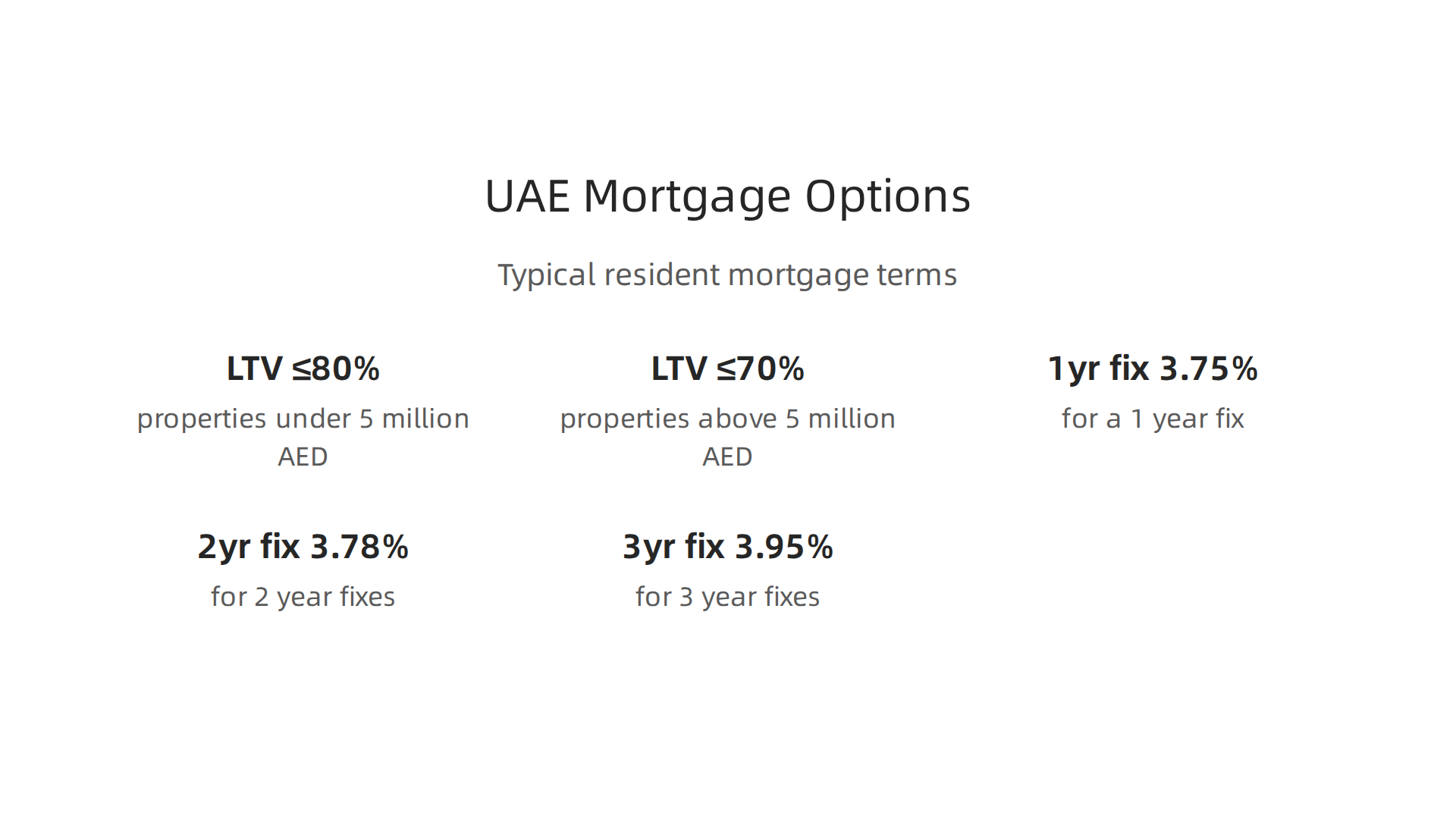
- LTV up to 80% for properties under 5 million AED
- LTV up to 70% for properties above 5 million AED
- Fixed rates starting around 3.75% for a 1 year fix
- Rates around 3.78% for 2 year and 3.95% for 3 year fixes
For non-residents:
- LTV typically 60% to 65%
- Down payment of 40% to 50% required
- Interest rates from about 4.25% to 6.50%
- Fixed rates available but often higher
A detailed guide on foreigner mortgage UAE eligibility tips for 2026 explains that banks like HSBC, FAB, Mashreq, and Dubai Islamic Bank all accept non-resident borrowers. You typically need to show a minimum monthly income of 10,000 to 15,000 AED.
The Wealth Management Approach to Mortgages
Here is where personalized wealth management really earns its keep. A smart financing strategy does not just hunt for the lowest rate. It looks at the whole picture.
First, your cash flow. Can your rental income comfortably cover your monthly mortgage payment? If the answer is no, you are taking on too much risk.
Second, your buffer. What happens if rates go up? What happens if property values drop 15% to 20%? You need savings set aside for rough patches.
Third, your timeline. Mortgages work best when you hold properties for years. Short term flipping with high leverage is gambling. Long term holding with manageable debt builds real wealth.
For a deeper look at structuring your financing strategy inside a broader plan, this guide on how private wealth management helps you invest in Dubai property walks through the key decisions you need to make.
The Safe Borrowing Rule
Here is a simple rule that works. Never borrow more than you could pay back even if your rental income dropped 30%. Keep your LTV at 60% or below unless you have strong cash reserves. And always keep at least six months of mortgage payments in savings.
That is what disciplined borrowing looks like. It is not flashy. But it keeps you safe when markets shift.
This is what we mean by modern wealth management. You use debt as a strategic tool, not a desperate move. And over time, that discipline creates real wealth you get to keep.
Long-Term Wealth Planning: Building Generational Wealth Through Dubai Property
Think about this. You buy a Dubai apartment today. Your child inherits it in 30 years. By then, that property has been generating rental income the whole time. And the value has grown many times over.
That is the heart of long-term wealth planning. And it is a big part of what is wealth management all about.

Wealth management is not just about this year’s returns. It is about making sure your money serves your family for generations.
Dubai real estate is a strong tool for that goal. Freehold ownership means you fully own the property. You can pass it to your heirs just like any other asset. But you have to plan carefully.
Know the Inheritance Rules Before You Buy
Here is something many investors miss. If you are a non-Muslim expat and you die in the UAE without a registered will, your assets get distributed by default inheritance rules. Those rules may not match your wishes. In fact, under the new 2026 UAE laws, if you have no will and no legal heirs, your entire UAE estate could become a charitable endowment.
That is why a proper estate plan is essential. The good news is that UAE law gives you clear options. You can register a DIFC Will or an Abu Dhabi Judicial Department Will to control how your Dubai property passes to your family. For example, a DIFC Will lets you distribute your assets exactly as you decide, using English common law principles.
For a detailed walkthrough on securing your legacy, check out this guide on Dubai wealth management guides smart property investment. It explains how to structure your holdings for maximum generational benefit.
Three Strategies for Generational Wealth Through Dubai Property
The most successful investors use a mix of these approaches:
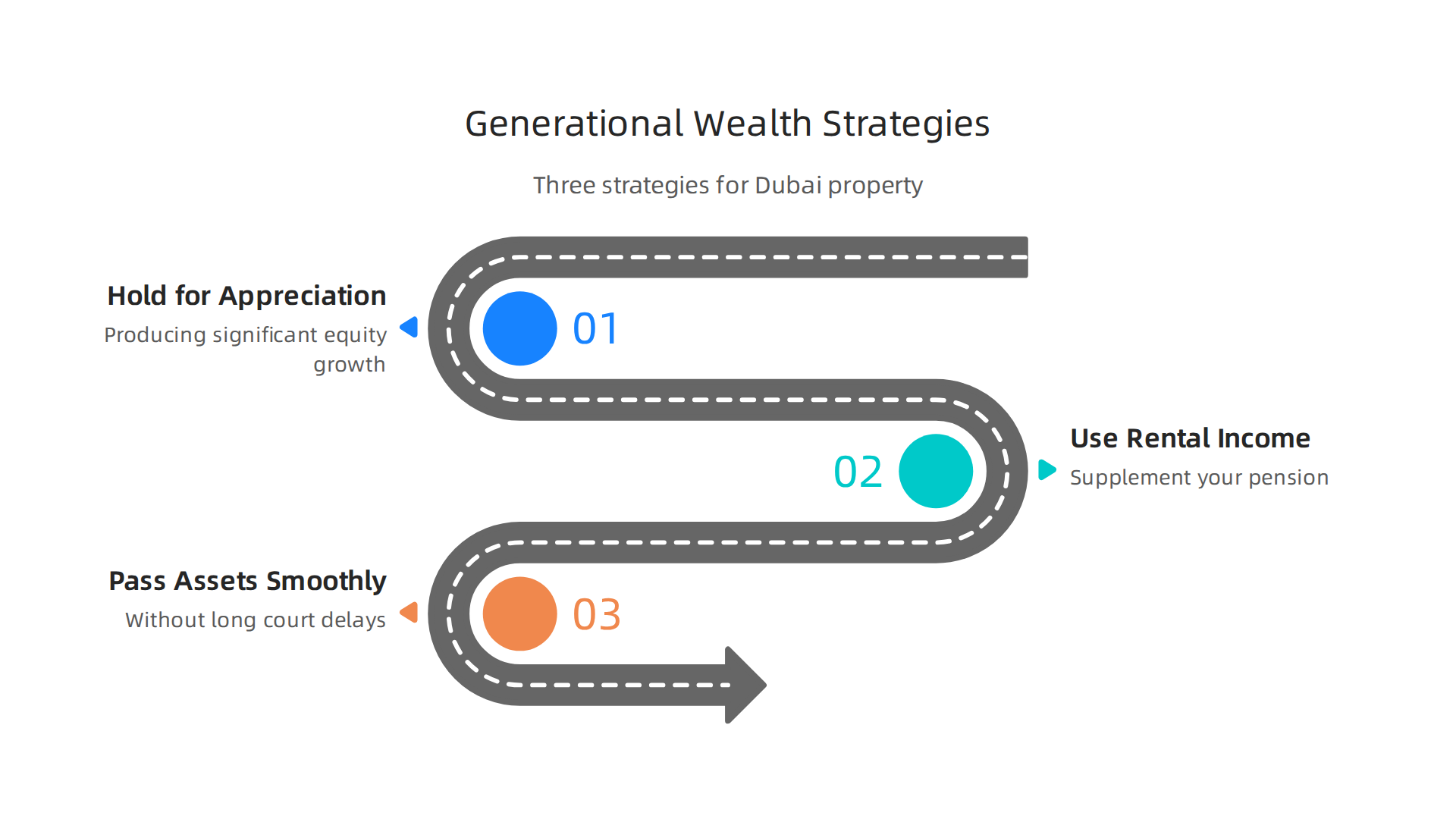
Hold for capital appreciation. Dubai property values have historically grown over multi-year cycles. Buying in established areas like Downtown Dubai or Dubai Marina and holding for 10 to 20 years can produce significant equity growth. That equity becomes your children’s foundation.
Use rental income for retirement. A fully paid off villa generating 60,000 to 100,000 AED per year in rent can supplement your pension. You live off the income, and the asset stays intact for your heirs.
Pass assets smoothly to heirs. With a registered will and proper ownership structure, your heirs can transfer the property to their name without long court delays. The UAE does not levy inheritance tax, which makes Dubai even more attractive for personal wealth management.
In fact, recent data from the World Wealth Report 2026 shows that high net worth investors globally now allocate about 25% of their portfolios to equities and a significant share to real estate and cash. The pattern is clear: the wealthy build their future on assets that produce steady returns and hold value over time.
Why Dubai Works for Generational Goals
Dubai offers something rare in today’s world. Political stability, a strong legal system, and zero capital gains tax. The UAE has positioned itself as a safe haven for capital. That makes it ideal for modern wealth management that looks decades ahead.
The personalized wealth management approach means you tailor your property choices to your family’s specific needs. Maybe you want a property near good schools for your grandkids. Maybe you want a commercial unit that produces higher income. Either way, the goal stays the same. Protect what you build and pass it on.
Are you ready to start your generational wealth plan in Dubai? The first step is a conversation with someone who understands both the local market and long-term strategy. Get your FREE Dubai Real Estate Consultation by connecting with Ayaz Salman today. He can help you map out a plan that fits your family’s future.
Summary
This article explains what wealth management means for Dubai real estate investors and shows how a holistic approach turns individual property purchases into a coherent financial plan. It defines private wealth management, details the central role of asset allocation, and explains practical allocation examples for ready, off‑plan, commercial and liquid real estate exposure. The guide highlights key risks—market volatility, off‑plan delays, currency swings and regulation—and offers risk‑management tools like insurance, legal due diligence and exit strategies. It also outlines Dubai’s major tax advantages (no personal income or capital gains tax) alongside actual fees you must pay, and covers mortgage options, leverage rules and safe borrowing practices. Finally, the article describes long‑term estate planning and inheritance considerations to help you build generational wealth and shows when to hire a fiduciary or wealth manager.